End-to-end 5G testing is hard. Deploying a gNB on real hardware, connecting it to a live O-RU, running traffic, and collecting results requires coordinating multiple systems that were never designed to talk to each other automatically. Before this work, every change to a network function configuration meant manual intervention. An operator would re-tune CPU allocation, re-deploy containers, and re-run tests by hand.
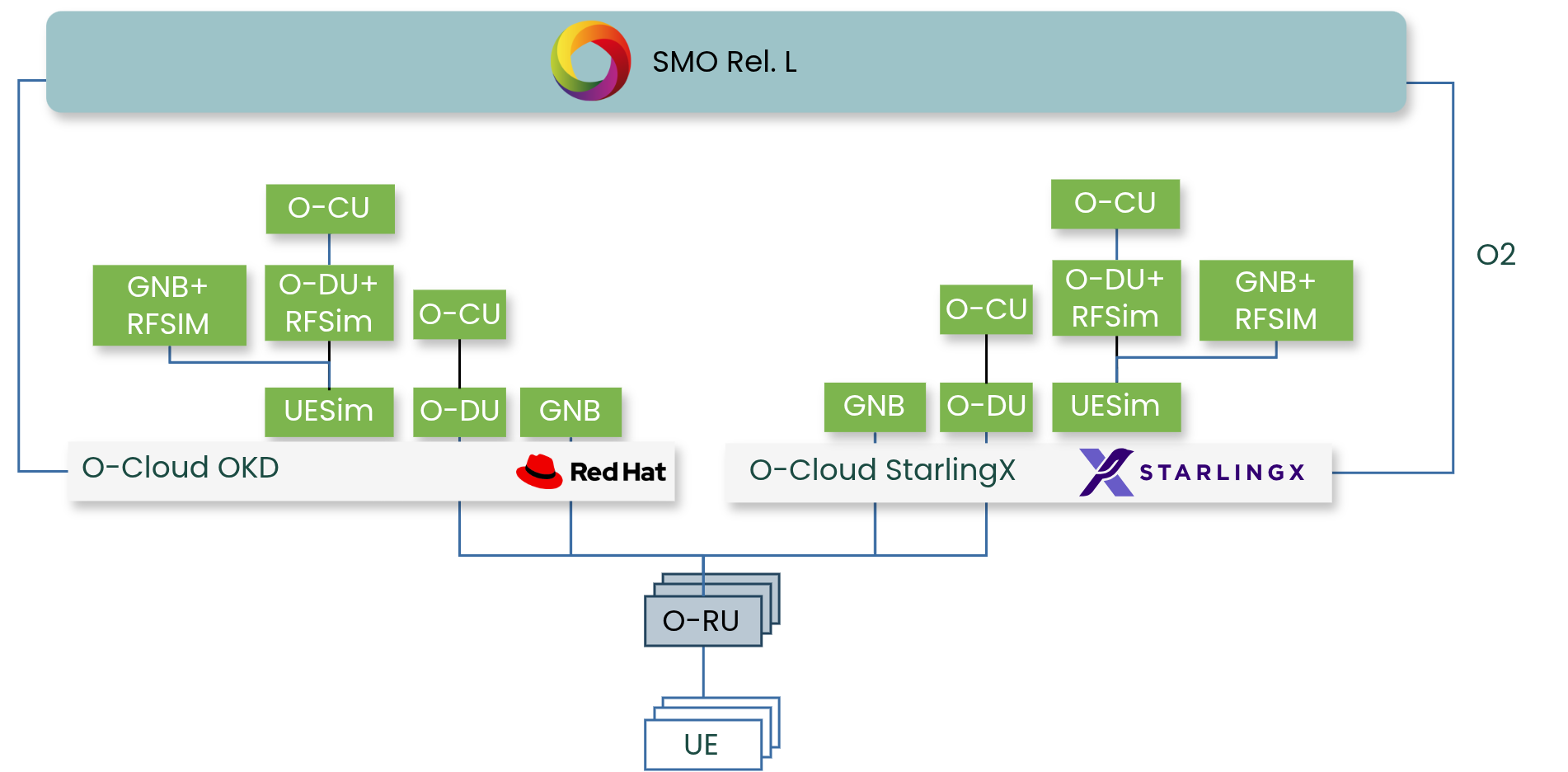
This framework removes that operator from the loop. It takes a set of test constraints as input, turns them into deployment requests against an O-Cloud, runs over-the-air traffic tests against a live O-RU, and collects resource profiling data from the gNB node. The gNBs are OAI containers running on Kubernetes across two O-Cloud platforms, StarlingX and OKD. The O-RUs are LiteON and Pegatron units using 7.2x fronthaul split.
The Problem
Manual 5G integration testing does not scale. A single configuration change (CPU isolation, hugepage allocation, fronthaul bandwidth target) requires redeployment and retesting by hand. On COTS hardware with diverse server profiles, every node needs individual tuning. There was no mechanism to systematically vary these parameters, deploy across multiple O-Cloud sites, and collect results without human involvement at each step.
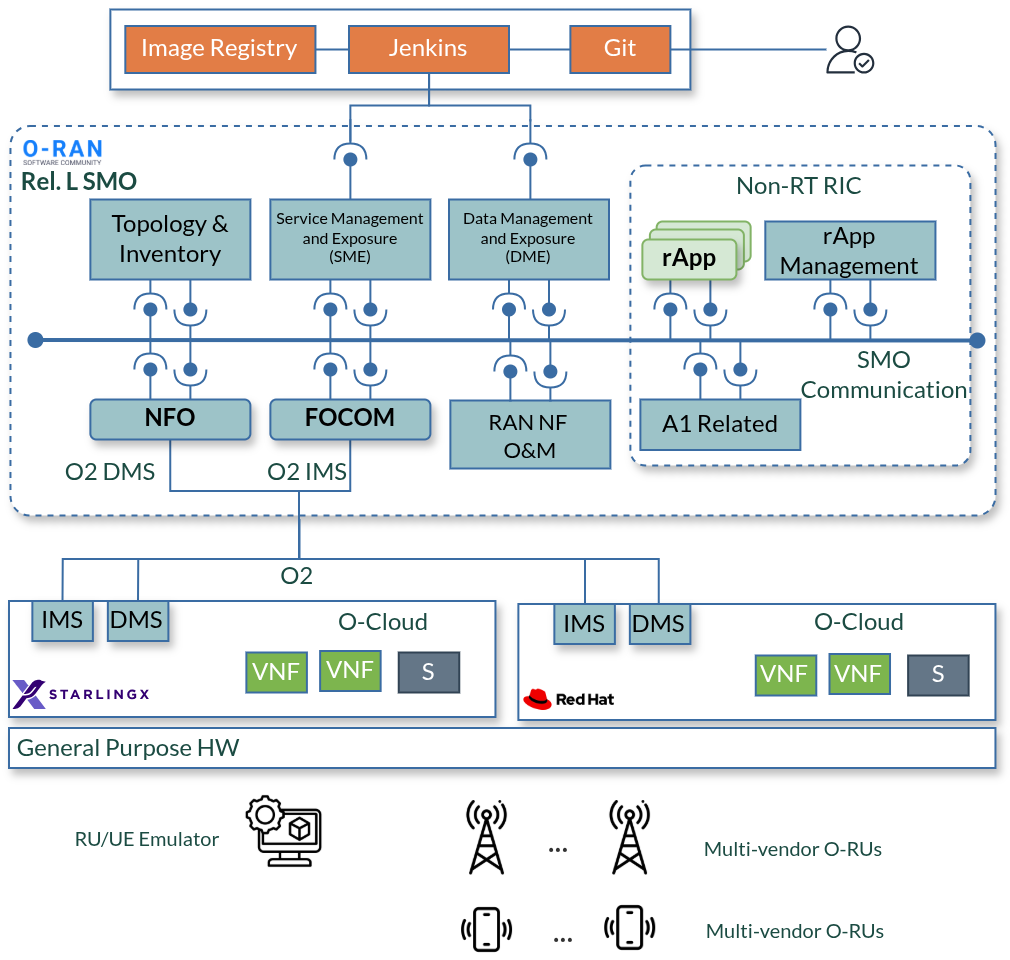
The O-RAN O2 interface defines a standard way for the SMO to manage O-Cloud infrastructure and deploy network functions. This work uses that interface as the automation boundary. Everything south of the O2 is handled programmatically.
What I Built
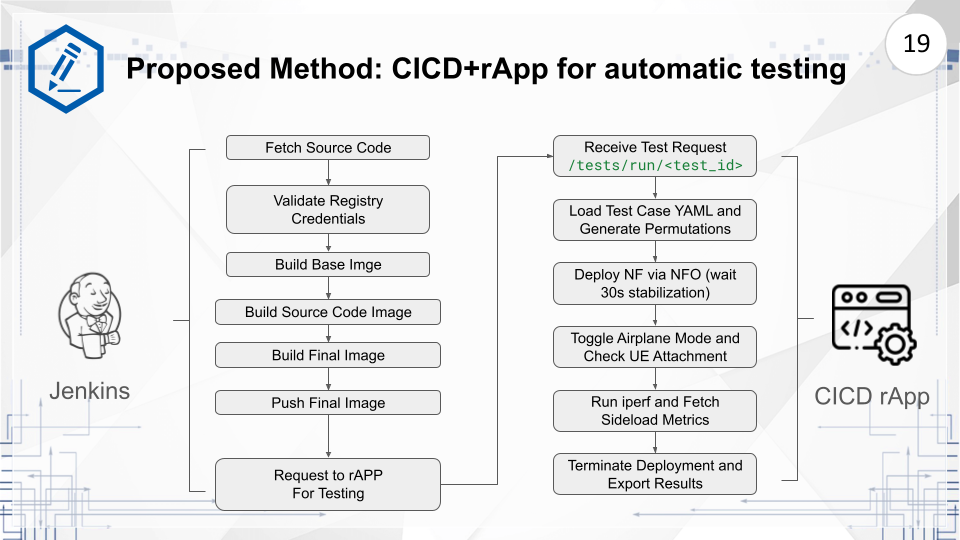
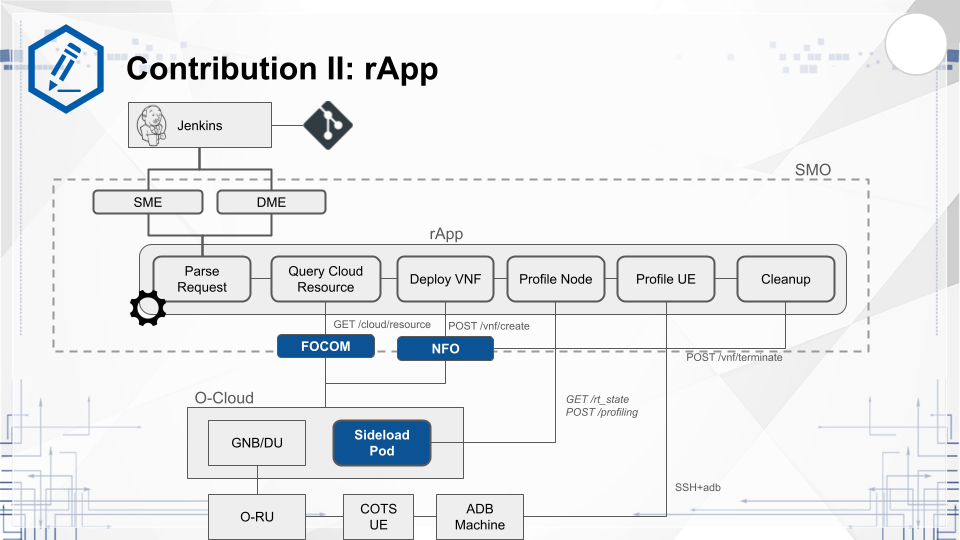
The pipeline starts with a REST API call to the rApp carrying a test descriptor. The rApp translates that descriptor into deployment requests toward the NFO, which forwards them to the target O-Cloud DMS. Once the gNB is up, the rApp sends an ADB command to the UE to start iperf traffic. A sideload container running on the same node as the gNB measures CPU and memory usage throughout the test. Results are collected and reported back to the CI/CD stack.
The test descriptor drives the entire run. It specifies the target O-RU and cell, the Helm charts to deploy, the CPU cores to isolate, the traffic loads to test, and the duration of each run.
{
  "testId": "publish-my-own-case",
  "testType": "BANDWIDTH_SCALING",
  "description": "F1 split test - LiteON O-RU - Joule - CU/DU",
  "target": {
    "oduUrn": "urn:o-ran:gnb:joule-liteon",
    "cellUrn": "urn:o-ran:cell:joule-liteon",
    "sideloadInstanceId": "139d2f51-b3c2-4a94-a6a3-401464537f23",
    "cluster": "cc1397ba-b1c4-4a3e-bc8d-6af58ef53818"
  },
  "nf": [
    {
      "artifactName": "oai-cu",
      "artifactRepoUrl": "https://github.com/motangpuar/ocloud-helm-templates.git",
      "branch": "starlingx/liteon",
      "image": {
        "repository": "oaisoftwarealliance/oai-gnb-fhi72",
        "version": "2026.w04"
      },
      "extra": { "amfhost": "192.168.8.103" }
    },
    {
      "artifactName": "oai-du-fhi-72",
      "artifactRepoUrl": "https://github.com/motangpuar/ocloud-helm-templates.git",
      "branch": "starlingx/liteon",
      "image": {
        "repository": "oaisoftwarealliance/oai-gnb-fhi72",
        "version": "2026.w04"
      },
      "parameters": {
        "wr_isolcpus": [8, 14],
        "iperf_bandwidth_mbps": [100, 400, 700]
      },
      "baseline": {
        "wr_isolcpus": 10,
        "memory": "16Gi",
        "hugepages": "16Gi"
      }
    }
  ],
  "execution": {
    "runsPerCase": 1,
    "stabilizationTime": 30,
    "iperfDuration": 60
  }
}
SMO Components
The SMO side consists of three components. NFO handles network function lifecycle over O2dms. It takes the deployment descriptor from the rApp and translates it into Helm releases on the target Kubernetes cluster.
smo-o2NFO module. Handles VNF deployment lifecycle over O2dms via Helm.
FOCOM manages the O-Cloud infrastructure side over O2ims. It queries available computation resources from each registered O-Cloud site and feeds that information into placement decisions for each deployment.
smo-o2-focomFOCOM module. Queries O-Cloud resource inventory over O2ims.
The rApp is the CI/CD entry point. It is triggered by Jenkins on completion of a gNB build, receives the test descriptor, and orchestrates the full pipeline. It handles deployment, traffic testing, and result collection.
cicd-rapp-clientrApp CI/CD client. Orchestrates gNB deployment and over-the-air testing.
O-Cloud
Two O-Cloud platforms were used in this work to validate the framework across different infrastructure stacks.
StarlingX is a distributed cloud platform optimized for low-latency edge workloads. It was the primary platform in this work. The Pegatron O-RU achieved full end-to-end connectivity on StarlingX across all tested configurations. CPU isolation and real-time kernel tuning were stable throughout.
OKD (the community distribution of OpenShift) was the second target. SR-IOV configuration and real-time kernel requirements introduced integration challenges that did not appear on StarlingX. The LiteON O-RU showed failures at high bandwidth loads on this platform.
Sideloader
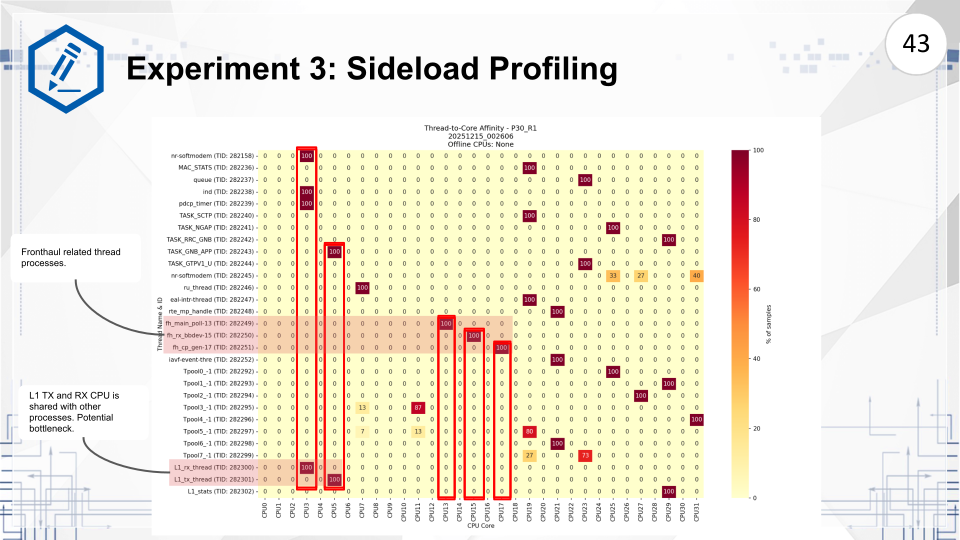
The sideload container runs directly on the same node as the gNB during each test run. It is not part of the O2 flow. It operates independently, measuring CPU thread utilization, memory consumption, and hugepage usage at the hardware level. This data is what makes the experimental results meaningful. You can see exactly what the gNB is doing to the hardware under each traffic load.
ocloud-tester-sideloadSideload container for gNB resource profiling on O-Cloud nodes.
Results
The framework successfully identified faulty combinations of expected traffic load and CPU allocation when using 7.2x fronthaul split. Tests were run across two platforms, two O-RU vendors, and three traffic targets.
| Platform | Deployment Split | O-RU | CPU Allocation | Traffic (Mbps) |
|---|---|---|---|---|
| OKD, StarlingX | Monolithic, F1, NFAPI | LiteON, Pegatron | 8, 14 cores | 100, 400, 700 |
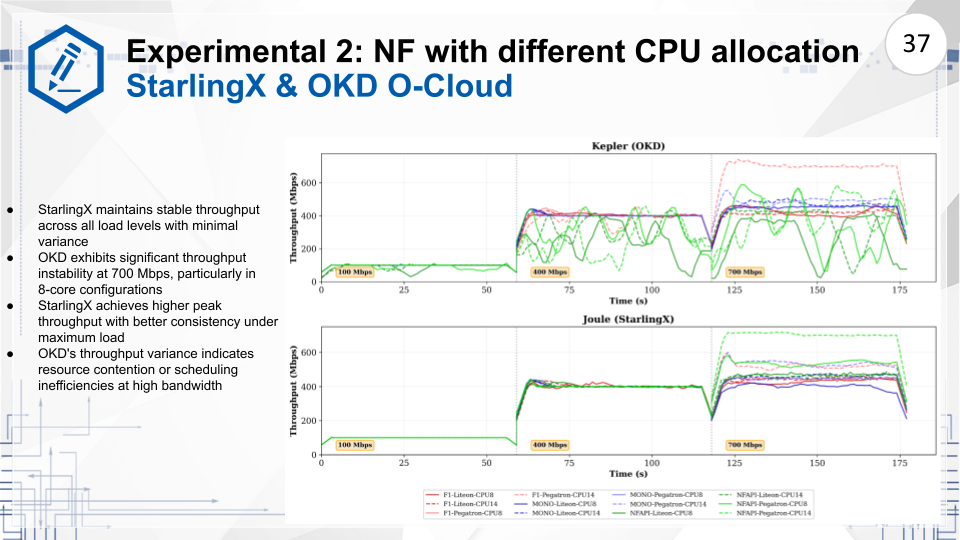
The CPU affinity data from the sideloader shows thread distribution across cores during active traffic. Where gNB threads spill onto non-isolated cores, throughput degrades at higher bandwidth targets.
OSC Contribution
The NFO and FOCOM modules were submitted to the O-RAN Software Community PTI-O2 project via Gerrit and merged upstream. The code ran in the OSC Asia Pacific lab against a StarlingX-based O-Cloud with OpenShift worker nodes.